
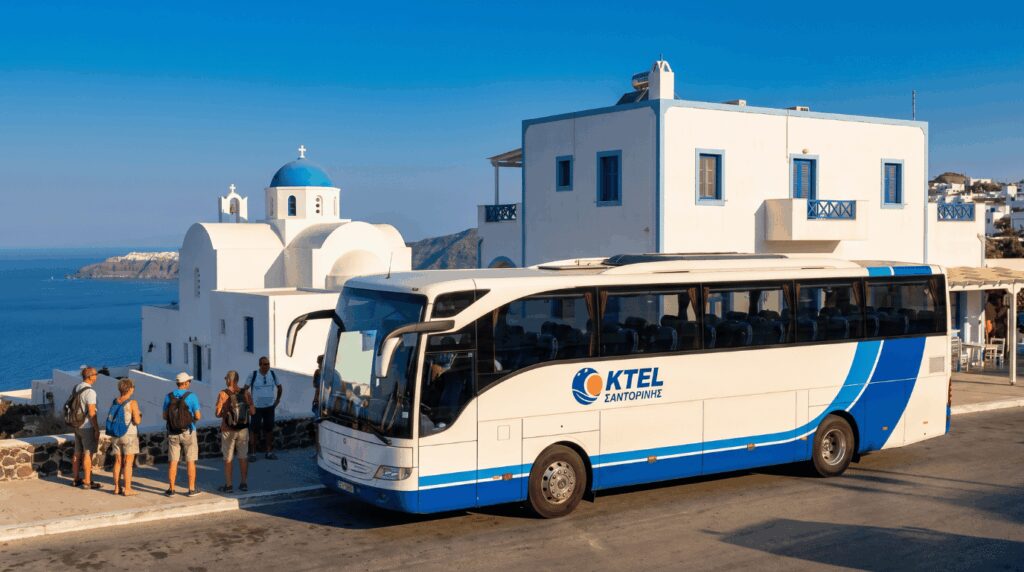
Quick Answer: How the Santorini Bus System Works
Santorini’s public buses run on a hub-and-spoke network centered on Fira, operated by KTEL Santorini. Most cross-island trips need one transfer there. One-way fares run roughly €2.20 to €2.80, paid in cash to a conductor on board. Buses run often in summer, sparsely in winter.
That single rule, everything routes through Fira, explains most of the confusion travelers feel on day one. Learn it, and the Santorini bus map suddenly makes sense.
We run shared and private transfers on this island year-round, so we watch the bus schedule shift with every ferry and flight. This guide gives you the working version: how routes connect, what tickets cost, where the timetable lies to you, and when the bus is the wrong call.
Local note: Timetables on Santorini change with the season, the day, and even the weather. Treat every time below as a planning estimate. Always confirm against the printed board at Fira station or the official KTEL site on the day you travel.
Who Runs the Buses in Santorini?
The island’s intercity buses are operated by KTEL Santorini, the local branch of Greece’s national KTEL network. KTEL is not one company in the corporate sense. It is a cooperative of private bus owners who pool routes under one brand, which is why the buses vary in model, color, and condition from one route to the next.
A few facts that shape your trip:
- The fleet is small. As of 2026, only about 23 public buses serve the entire island, and many run only in peak summer.
- Buses are air-conditioned coaches, not city minibuses. Seats are comfortable, and luggage usually rides in the hold underneath.
- There is no reliable live tracking app, and no integrated journey planner like you find in Athens.
This is a tourist-season transport system stretched across one of Greece’s busiest islands. It works, but it rewards travelers who plan.
Fira Bus Station: Where Is the Main Bus Station in Santorini?
The Fira bus station is Santorini’s central bus station. It sits in Fira, the island’s capital, a short walk from the main square. This is the heart of the network. All bus routes originate and terminate at the main station in Fira.
Why Fira Matters for Every Trip
Because of the hub-and-spoke design, you cannot assume a direct bus between two villages. To travel between two outer points, for example Oia to Kamari, you first ride to Fira, then transfer to a second bus and pay a new fare.
Plan for this. A short hop between neighboring beaches can mean a detour through the center of the island.
What to Expect at Fira Bus Station
The station is functional, not polished. Buses line up with destination signs in the windscreen, and a conductor or driver directs boarding.
- Shade is limited. Bring a hat, water, and sunscreen if you wait in summer.
- Shops nearby sell water and snacks, and ATMs are within a short walk.
- The printed timetable board at the station is the single most reliable source on the island. Photograph it when you arrive.
- Every main line leaves from here: Oia, the airport, Athinios Port, Kamari, Perissa and Akrotiri. Check the destination sign on the windscreen before you board.
What Are the Main Santorini Bus Routes?
Every route below connects to Fira. Times reflect typical 2026 peak-season patterns, not guarantees.
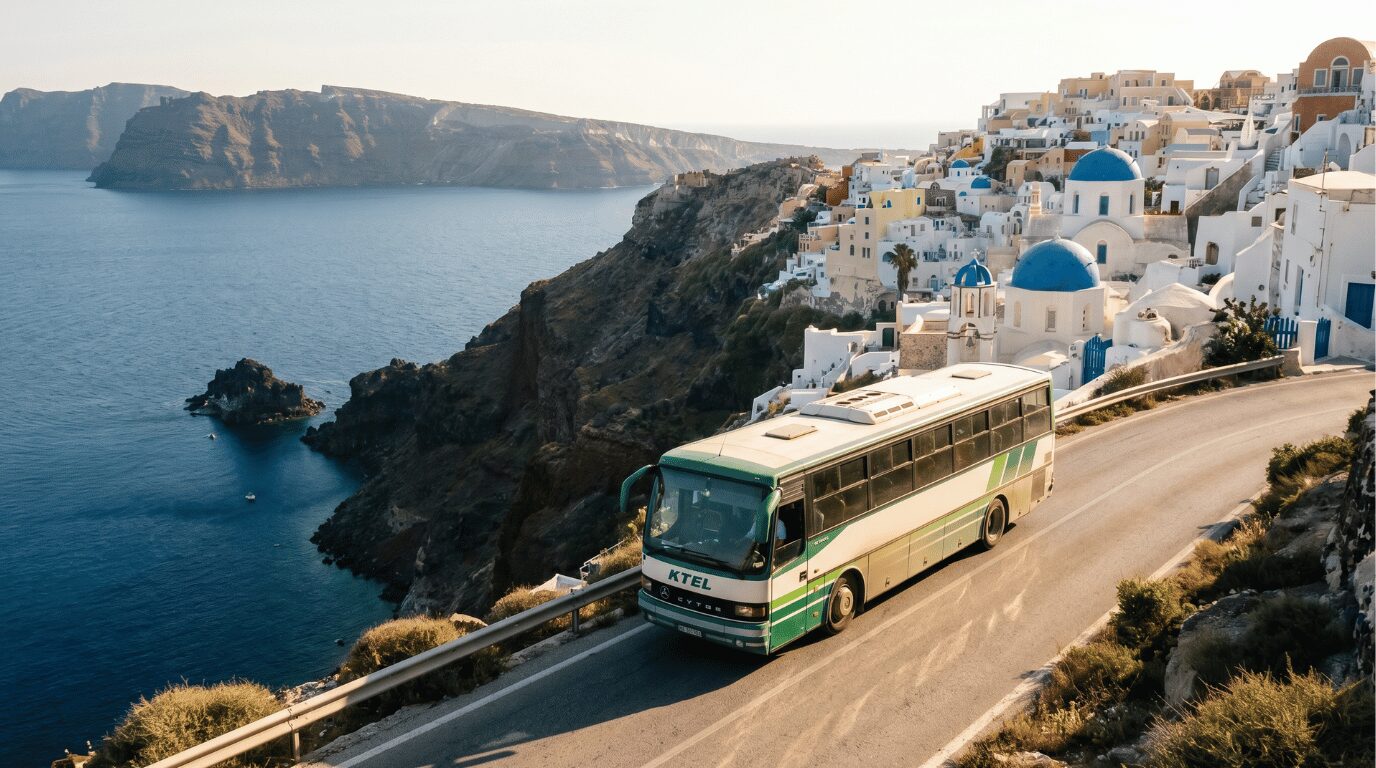
Fira to Oia (the Sunset Route)
The most-ridden tourist line on the island. The ride takes around 25 to 30 minutes, and buses run roughly every 30 minutes in summer.
- Heads up: This route fills fast before sunset. On a typical timetable the last Fira to Oia bus is around 20:00, with the last return near 20:20, though peak summer can add later services.
- If you ride out for sunset, the return is the chokepoint. Hundreds of people compete for a few buses, and many wait an hour or more.
Fira to the Airport (JTR)
A direct line that aligns with flight schedules. The ride takes about 10 minutes and the 2026 fare is around €2.20.
The catch is timing. Bus frequency does not match every flight, and early-morning or late-night departures often fall outside the schedule. For a flight with bags, this route carries real risk.
Fira to Athinios Port (the Ferry Port)
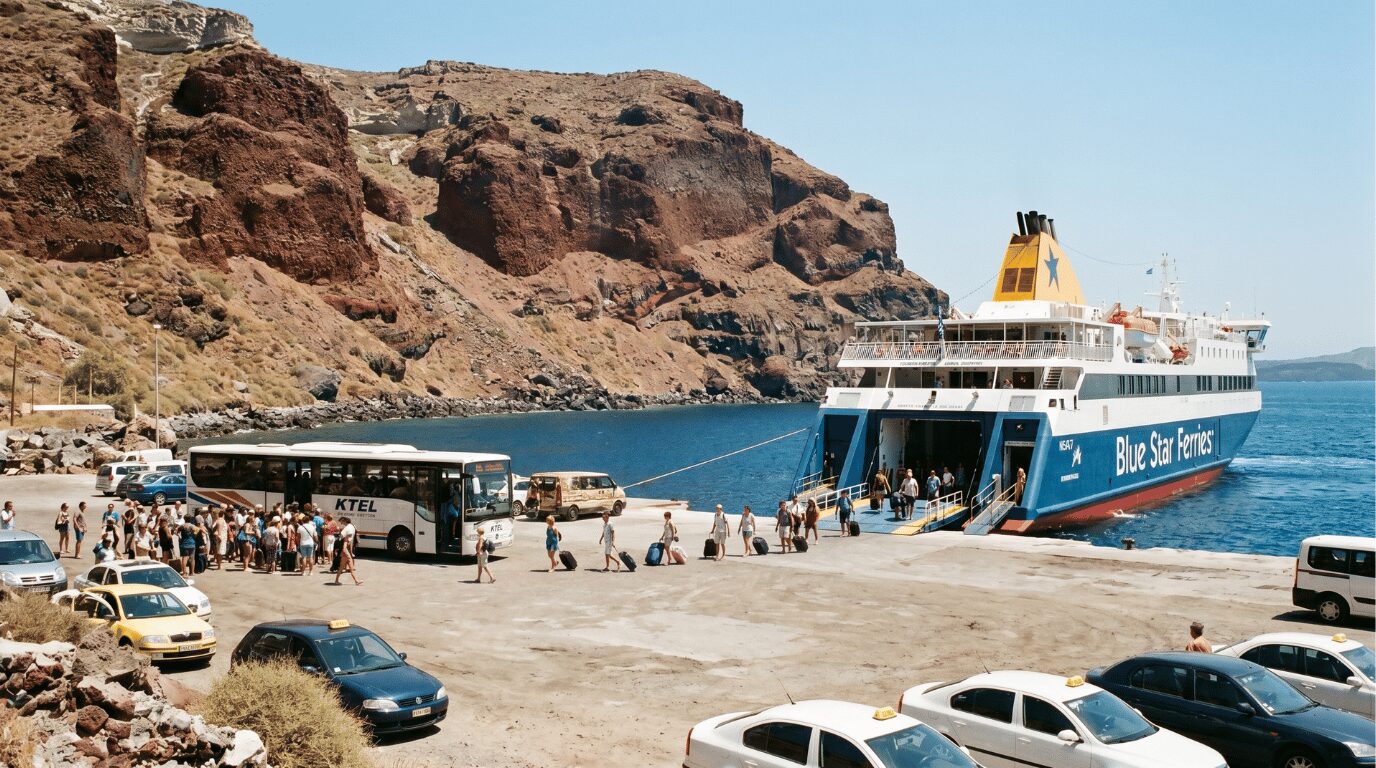
This is the trickiest route on the island. Buses connect Fira with Athinios, Santorini’s main ferry port, but the timetable shifts around ferry arrivals and departures.
- The Athinios schedule can change daily and even depends on the weather, because the ships do.
- Buses from the port usually run to Fira only. From Fira you transfer onward to Oia, Kamari, Perissa, or elsewhere.
- After a delayed late ferry, demand spikes and buses fill instantly.
Fira to the Beaches (Kamari, Perissa, Perivolos)
The black-sand beach routes are well served in summer. Fira to Kamari runs every 20 to 30 minutes in peak season, with Perissa and Perivolos on a similar pattern.
One quirk trips people up: to go from Kamari to Perissa, two beaches close as the crow flies, you still transfer through Fira. There is no coastal shortcut by bus.
Other Useful Lines
- Fira to Akrotiri, for the archaeological site and Red Beach viewpoint, seasonal and less frequent.
- Fira to Pyrgos, Megalochori, and Emporio, inland villages on the southern routes.
- Fira to Vlychada and Monolithos, limited daily services.
Note on Red Beach: Treat Red Beach as a viewpoint stop, not a swim spot. Rockfall hazards make the cove unsafe, so admire it from above and move on.
How Much Does the Santorini Bus Cost?
Tickets are single-ride only. Santorini has no weekly, monthly, or seasonal passes; every ride is a single ticket.
Current 2026 Fares
Fares range from about €2.20 to €2.80 depending on distance, with most common routes around €2.20. Night buses, which are rare, run slightly higher, roughly €2.50 to €3.10.
| Route (one way) | Typical 2026 fare | Approx. duration |
|---|---|---|
| Fira to Oia | €2.20 | 25 to 30 min |
| Fira to Airport (JTR) | €2.20 | 10 min |
| Fira to Athinios Port | €2.50 to €2.80 | 20 min |
| Fira to Kamari | €2.20 | 20 to 25 min |
| Fira to Perissa | €2.20 to €2.50 | 25 to 35 min |
Fares confirmed against multiple 2026 sources; KTEL adjusts prices in-season, so verify on the day.
How to Pay for Your Ticket
This is where tourists get caught out.
- Cash only. All ticket sales are in cash (euros); credit cards are not accepted.
- Pay the conductor, not a machine. An attendant collects the fare as you board at main stations, or comes to your seat once the bus is moving.
- Carry small change. Conductors dislike large notes, and on a crowded bus you want exact coins ready.
Tip: KTEL is testing tap-to-pay on some newer buses for 2026, but treat cash as your primary method and carry it every time.
Are There Discounts?
Students can receive about 25% off, and a 50% discount applies for large families or passengers with disabilities. International travelers should expect the full adult fare, and note that the buses are not wheelchair-accessible despite the mobility discount.
Santorini Bus Schedule 2026: What Is the Timetable?
Here is the honest version: there is a timetable, and there is reality. Use the Santorini bus schedule below to plan, then confirm on the day.
Santorini Bus Schedule at a Glance
| Route (from Fira bus station) | Peak season (June to September) | Off-season | Good to know |
|---|---|---|---|
| Fira to Oia | About every 30 min (25 to 30 min ride) | About hourly | Last bus around 20:00, last return around 20:20 |
| Fira to Airport (JTR) | Timed around flights (about 10 min ride) | Fewer services | Early and late flights often fall outside the schedule |
| Fira to Athinios Port | Timed around ferry arrivals (about 20 min ride) | Fewer services | Changes daily with ferries and weather |
| Fira to Kamari | Every 20 to 30 min (20 to 25 min ride) | About hourly | Well served in summer |
| Fira to Perissa / Perivolos | Every 20 to 30 min (25 to 35 min ride) | About hourly | No coastal bus between Kamari and Perissa |
| Fira to Akrotiri | Seasonal, less frequent | Limited | For the archaeological site and Red Beach viewpoint |
2026 planning estimates. Confirm on the board at Fira bus station or on ktel-santorinis.gr on the day you travel.
The Seasonal Pattern
During peak season, June to September, buses run roughly every 30 minutes from early morning to late evening. In the off-season they may run only hourly. More routes appear across the summer peak and get cut back sharply in winter.
Why You Cannot Fully Trust the Printed Times
Travelers report buses leaving early, not just late. One common account: a rider showed up early for a 10:00 Fira to Oia bus, got moved between buses by a conductor, and the bus departed ten minutes ahead of schedule. The lesson is simple.
- Arrive 15 to 20 minutes early for any bus you need to catch.
- Know your stop and speak up. Buses skip stops if no one signals, so tell the conductor where you get off.
- Photograph the station board rather than relying on times found online.
Where to Check the Official Schedule
For same-day accuracy, use the official KTEL Santorini site (ktel-santorinis.gr) and the printed board at Fira. For urgent questions you can call the KTEL Fira office at +30 22860 25404. Third-party blogs are useful for patterns but go stale fast.
Should You Take the Bus or a Private Transfer in Santorini?
The bus is the cheapest way to move around Santorini. It is not always the smartest, and the difference shows up at exactly the moments that matter most: arrival and departure.
When the Bus Is the Right Call
- You are staying in Fira, Oia, Kamari, or Perissa and your plans match the schedule.
- You travel light, with no bulky luggage to manage.
- You have a flexible day with room to absorb a missed connection.
For day trips between the main towns with timing that lines up, the bus works well.
When to Skip the Bus
The bus struggles in the precise situations where a smooth ride matters most.
- Airport and port runs with luggage. A missed ferry or flight costs far more than a transfer.
- Early-morning or late-night travel, outside the thin schedule edges.
- Cruise arrivals. Cruise ships dock at the Old Port below Fira, reachable only by cable car, donkey, or walking, not by road. There is no bus at the Old Port. We meet cruise guests at the top of the cable car in Fira instead.
- Wineries, remote beaches, and group travel, where transfers and connections eat your day. For these, renting a car or booking a transfer is far more flexible.
The Real Cost Comparison
A single bus ride looks cheap. A full day of island-hopping does not. Complex routes with multiple transfers can run to several dozen euros across a day, since each leg is a new ticket.
Two or three people splitting a private fare often pay a similar amount with none of the waiting, transfers, or stranded-at-sunset risk.
If you want a fixed price, a named driver, and a meet-and-greet on arrival, compare a private Santorini transfer against the bus for your specific route. For the trade-offs in depth, see our guide on private transfer vs taxi in Santorini.
What Are the Best Insider Tips for Riding the Santorini Bus?
Hard-won advice from people who watch this system every day:
- Build everything around Fira. Plan trips as village to Fira, Fira to village. Assume a transfer.
- Never cut it fine for a ferry or flight. The Athinios and airport timetables are the least reliable on the island.
- For sunset in Oia, ride out early and accept a long wait back, or pre-book a return transfer. The post-sunset crush is real.
- Keep a stash of coins. Conductors move fast and large notes slow everyone down.
- Sit toward the front on busy routes so the conductor sees your stop request.
- Screenshot the Fira board and your route times before you lose signal.
- In winter, expect frequencies to halve, and budget extra waiting time everywhere.
Conclusion: Make the Santorini Bus Work for You
The Santorini bus system is cheap, scenic, and entirely usable once you accept its logic. Everything routes through Fira. Fares sit around €2.20 to €2.80, paid in cash on board. The timetable is a guide, not a contract, so arrive early and confirm times on the day.
Use the bus for relaxed daytime trips between the main towns. Skip it for tight airport runs, late ferries, cruise pickups, and heavy luggage, where the savings vanish against the stress.
Plan around the hub, carry coins, and respect the schedule’s mood swings, and the bus becomes a genuinely pleasant way to see the island. When the stakes are higher, a private transfer buys back the time and certainty the bus cannot promise.
Frequently Asked Questions
How much is a bus ticket in Santorini in 2026?
Most one-way fares cost between €2.20 and €2.80, with common routes around €2.20. Night buses run slightly higher, roughly €2.50 to €3.10. Tickets are single-ride only; there are no day or weekly passes.
Can I pay for the Santorini bus with a card?
No. Santorini buses take cash (euros) only, collected by a conductor on board. Some newer buses are trialing tap-to-pay for 2026, but you should always carry cash and small change.
Where is the main bus station in Santorini?
The central station is in Fira, the island’s capital. Nearly every route starts and ends there, so most trips between other villages require a transfer in Fira.
Is there a direct bus from Santorini airport to Oia?
No direct line. You take a bus from the airport (JTR) to Fira, then transfer to a second bus to Oia. The airport-to-Fira leg takes about 10 minutes.
Does the bus go to Athinios ferry port?
Yes, but the schedule shifts daily around ferry arrivals and can change with the weather. Port buses generally run to Fira only, where you transfer onward. Confirm times at the Fira station board before you travel.
Is there a bus from the Old Port (cruise port) in Santorini?
No. Cruise ships dock at the Old Port below Fira, reachable only by cable car, donkey, or on foot. There is no bus there. Reach the bus network by going up to Fira first.
How often do Santorini buses run?
In peak season (June to September) popular routes run roughly every 30 minutes from early morning to late evening. In the off-season frequency drops to about hourly with fewer routes.