
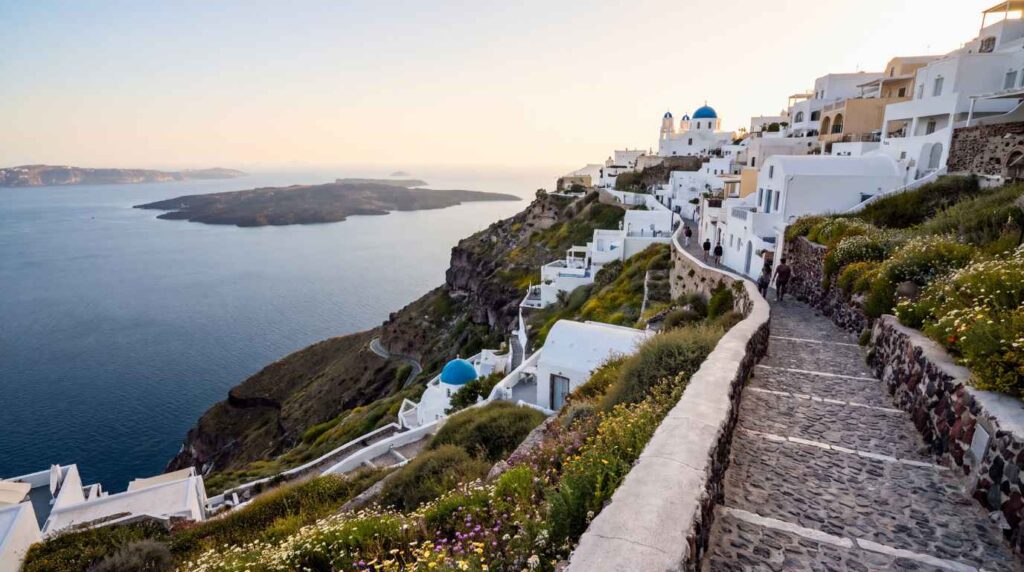
Ask ten people about the best time to visit Santorini and you will get ten answers. One swears by June, another by October, a third tells you to avoid summer at all costs. All of them are partly right, because the right month depends on what you want from the trip.
We run transfers and tours on the island all year, so we see every season from the driver’s seat. Weather is only half the story. The other half is what actually runs each month: flights, ferries, buses, taxis, hotels and restaurants.
This guide covers both. You get the weather and crowds for every month, the best season for each type of trip, and the on-the-ground changes most guides leave out.
Quick Answer: When is the best time to visit Santorini?
The best time to visit Santorini is late May to June, or September to early October. Daytime highs sit between 23 and 27°C (73 to 81°F), the sea is warm enough to swim, and crowds and prices sit below the July and August peak. Nearly every hotel, restaurant, ferry and bus route operates. For the lowest prices and the quietest villages, come from November to March, but expect cool weather, closed hotels in Oia and Imerovigli, and fewer buses, flights and ferries.
Santorini month by month at a glance
Use this table to compare months quickly. The sections below explain each season in more detail.
| Month | Daytime high | Sea | Crowds | What runs |
|---|---|---|---|---|
| January | around 14°C (57°F) | around 16°C | Very quiet | Winter timetables; many hotels closed |
| February | around 14°C (57°F) | around 15°C | Very quiet | Winter timetables; many hotels closed |
| March | around 16°C (61°F) | around 15°C | Quiet | Hotels start reopening late in the month |
| April | around 19°C (66°F) | around 16°C | Moderate | Season opens; first direct flights and cruise calls |
| May | around 23°C (73°F) | around 19°C | Moderate, rising | Almost everything open |
| June | around 27°C (81°F) | around 22°C | Busy | Full summer service |
| July | around 29°C (84°F) | around 24°C | Peak | Full summer service; strong meltemi wind |
| August | around 29°C (84°F) | around 25°C | Peak | Full summer service; strong meltemi wind |
| September | around 26°C (79°F) | around 24°C | Busy, easing | Full summer service |
| October | around 23°C (73°F) | around 22°C | Moderate | Winds down after the clock change |
| November | around 19°C (66°F) | around 20°C | Quiet | Winter timetables begin; Oia largely closed |
| December | around 16°C (61°F) | around 17°C | Very quiet | Winter timetables; Fira livelier at Christmas |
Figures are long-term averages and vary year to year. For your actual dates, check the National Observatory of Athens forecast (meteo.gr) a few days out.
The best time to visit Santorini, by type of trip
Start with what you want from the island. Each goal points to a different window.
For beaches and swimming: mid-June to September
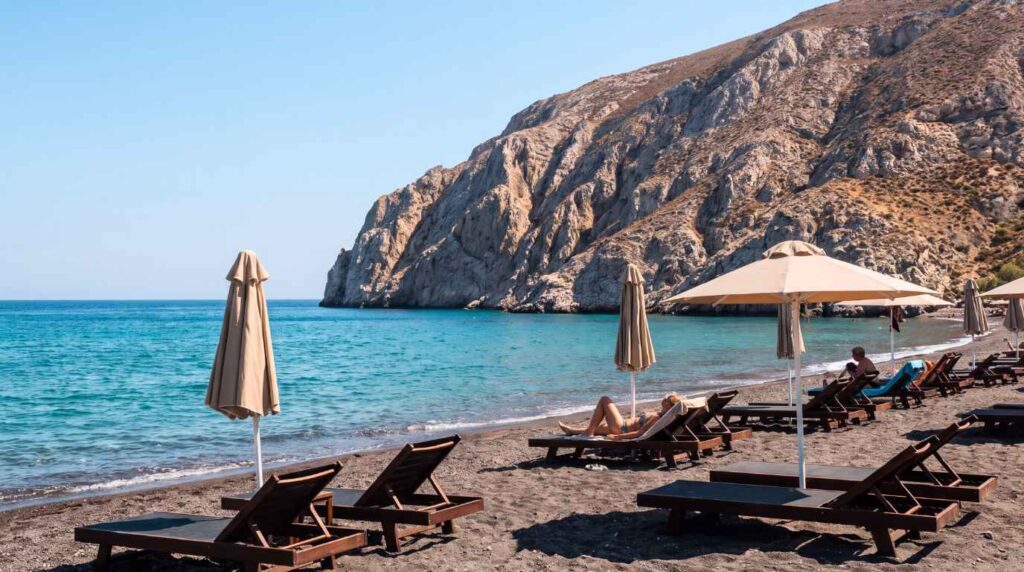
The sea reaches 22 to 25°C from mid-June and holds that warmth into late September. The black-sand beaches at Kamari and Perissa are the easiest choices, with sunbeds, tavernas and calm water on most days.
September is the sweet spot. The water is at its warmest of the year, and the beaches are noticeably calmer than in August.
For fewer crowds and good weather: late May and late September to mid-October
This is the classic shoulder season. You get warm days, open restaurants and running ferries, without the August crush in Oia and Fira. It is the best time to visit Santorini to avoid crowds while still enjoying the full island.
For the lowest prices: November to March
Hotel rates fall to their lowest of the year, and caldera views that cost a fortune in August become affordable. The trade-off is real: many hotels in Oia and Imerovigli close, the weather turns cool and changeable, and transport thins out. Our guide on whether Santorini is expensive breaks down costs by season.
For walking and hiking: April, May, October and November
The Fira to Oia caldera path runs about 10 km and has little shade after Imerovigli. In July and August, it is a dawn-only walk. In spring and autumn, you can start mid-morning and enjoy it. Our guide to getting from Fira to Oia covers the route and the easier alternatives.
For a honeymoon or sunset trip: May, June and September
These months combine warm evenings, long days and full restaurant choice. Sunset in Oia moves from around 8:10 pm in mid-May to around 8:45 pm in late June, then back to around 7:20 pm in mid-September. For a special arrival, our VIP transfers meet you at the airport or port.
For wine: August to October
Santorini harvests early. The hot, dry climate brings the Assyrtiko harvest forward to August, one of the earliest in Greece. Tastings run from spring to autumn, and September and October visits are slower and more personal.
Santorini season by season
Winter: December to February
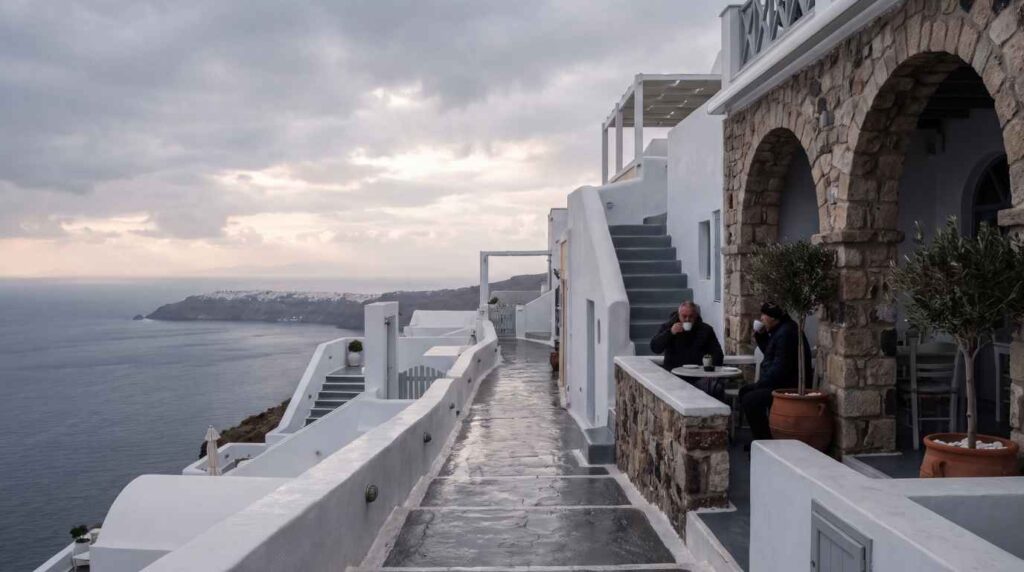
Winter is Santorini at its most local. Daytime highs sit around 14 to 16°C, rain falls on several days a month, and strong northerly winds make the caldera edge feel cold.
- Base yourself in Fira. It keeps the most year-round hotels, tavernas and bus links.
- Expect closures in Oia and Imerovigli. Most boutique hotels and cave suites shut for the winter.
- Fly through Athens. Direct international flights stop at the end of October, and the domestic hop from Athens takes about 45 minutes.
- Plan your transport. Buses run on a reduced winter timetable, and fewer taxis work.
Christmas and New Year bring some life back to Fira. Otherwise, winter suits travellers who want quiet, low prices and empty walking paths.
Early spring: March and April
The island wakes up. Hotels and restaurants reopen through March and April, the first seasonal flights return, and the countryside turns green after the winter rain.
The sea is still cold at around 15 to 16°C, so this is not a beach trip. It is a good time for walking, photography and wine tasting before the crowds arrive. Greece moves its clocks forward on Sunday 28 March 2027, and sunsets move past 7:30 pm.
Late spring: May to mid-June
For many visitors, this is the best time to visit Santorini island. Days are warm, evenings are mild, and nearly everything is open. The sea warms from around 19°C in May to around 22°C by mid-June.
Greek Orthodox Easter falls on 2 May 2027. It is the most important celebration of the year in Greece, with candlelit processions in the villages. It is also a busy week for Greek visitors, so book hotels and ferries early if your dates overlap.
Peak summer: late June to August
Summer brings the hottest weather, the warmest sea and the biggest crowds. Highs reach around 29°C, and the meltemi, a strong northerly wind, blows on many days in July and August. It cools the air but can roughen the sea and delay boat trips.
Crowds peak with the cruise ships. In 2024, Santorini saw days with more than 11,000 cruise passengers on an island with fewer than 16,000 residents. Greece now charges a €20 fee per cruise passenger from June to September, and the island applies a daily cap of 8,000 cruise passengers. Fira and the cable car still fill up by mid-morning on big ship days.
September
September keeps the summer weather and loses some of the crowds. Highs average around 26°C, the sea is at its warmest at around 24°C, and the meltemi usually eases. Cruise ships still call, so visit Fira early or late in the day.
October
October behaves like two months. Until the clock change on the last Sunday of the month, the island runs almost at full strength. After it, flights, ferries and buses shrink, and some hotels close. Our full guide to Santorini in October explains the difference.
November
November is the gateway to the quiet season: mild, mixed weather, low prices and empty caldera paths. Fira stays open, and Oia largely closes. Our guide to Santorini in November covers what stays open and how to get around.
What changes on the ground each season
Most guides stop at weather and crowds. As a local transfer operator, we see a third factor decide how smooth a trip feels: transport. Here is how it shifts through the year.
| Factor | Peak (late June to August) | Shoulder (April to May, September to October) | Winter (November to March) |
|---|---|---|---|
| Flights | Many direct routes from Europe | Direct routes start in spring and stop in late October | Mostly via Athens |
| Ferries | Frequent, including high-speed links | Good, thinning in late October | Conventional ferries from Piraeus; wind can cancel sailings |
| Buses | Busy, frequent, often full | Regular, with growing gaps late in the season | Reduced timetable; secondary routes run a few times a day |
| Taxis | Long queues at the airport and port | Shorter queues, still scarce when arrivals cluster | Fewer taxis working |
| Airport to Oia drive | Upper end of 25 to 35 min, with village traffic | Around 25 to 30 min | Lower end of 25 to 35 min |
Peak months: the problem is queues
Santorini has around 35 to 40 licensed taxis for the whole island. When several flights or ferries arrive together in summer, the rank at the airport or at Athinios Port empties fast, and the wait in the heat can run long. Buses fill at the first stop.
Winter months: the problem is gaps
In winter, the queues disappear, but so does choice. Buses run less often, fewer taxis work, and an evening arrival can leave you waiting a long time. Check the official KTEL Santorini timetable for your dates, and see our Santorini bus guide for how the network works.
The fix is the same in every month
A pre-booked transfer removes both problems. Our fixed prices do not change by season:
| Route | Journey time | Private transfer |
|---|---|---|
| Airport to Fira | 10 to 15 min | €40 |
| Airport to Kamari | around 10 min | €40 |
| Airport to Imerovigli | 20 to 25 min | €45 |
| Airport to Oia | 25 to 35 min | €60 |
| Airport to Perissa | about 25 min | €55 |
| Airport to Athinios Port | 20 to 25 min | €60 |
We track your flight and wait inside arrivals, so a delay costs you nothing. Arriving by sea? See our port transfers from Athinios.
Best time to visit Santorini to avoid crowds
The month matters, but the hour matters almost as much. These habits work in any season:
- Visit Fira before 10 am or after 5 pm on cruise days, when ship passengers leave or have not yet arrived.
- Arrive in Oia an hour before sunset if the view from the castle matters to you, or watch from Imerovigli or Firostefani instead.
- Walk the caldera path early, before the heat and the tour groups.
- Explore the inland villages, such as Pyrgos and Megalochori, which stay calm even in August. Our 5-hour private tour links Oia, Pyrgos and Red Beach with a local driver.
- Check the cruise schedule for your dates and plan Fira and Oia around the quieter days.
When is the worst time to visit Santorini?
There is no bad month, only a bad match. Two windows disappoint the most visitors:
- Late July to mid-August, if you dislike heat, crowds and peak prices. This is the busiest stretch of the year.
- January and February, if you expect a summer island. Many hotels close, the weather is cool and wet, and ferries can stop for wind.
If you want sunshine with the full summer infrastructure, early June or late September gives you the most for your money.
How to choose your month: a quick decision guide
- Want to swim every day? Choose mid-June to September.
- Want warm weather without the crowds? Choose late May, early June or late September.
- Travelling on a budget? Choose April, late October or November.
- Want empty villages and low prices, and do not need the beach? Choose November to March.
- Planning a honeymoon? Choose May, June or September.
Once you know your month, our local’s guide to where to stay in Santorini helps you choose the right village, and our guide on how to get to Santorini compares every route.

Mistakes to avoid when you plan
- Booking a winter hotel without confirming it is open. Seasonal closures are common in Oia and Imerovigli.
- Planning a tight ferry-to-flight connection. Wind can delay sailings in any month, and winter cancellations are common.
- Ignoring the clock changes. Sunset jumps by an hour at the end of March and the end of October.
- Arriving in peak season without a ride. Taxi queues at the airport and port are at their longest in July and August.
- Relying on the bus at night in winter. Services end early and run less often.
The takeaways
The best time to visit Santorini depends on your priorities. Here is what to remember:
- Late May to June and September to early October give you the best balance of weather, open businesses and manageable crowds.
- Mid-June to September is the beach season, with the sea at 22 to 25°C.
- November to March brings the lowest prices and the quietest villages, with closures and thinner transport.
- Transport changes with the season. Summer brings queues; winter brings gaps.
- A pre-booked transfer works in every month, at the same fixed price.
When your dates are set, book your Santorini transfer and we will meet you on arrival.
FAQ: Best time to visit Santorini
What is the best month to visit Santorini?
June and September are the best all-round months to visit Santorini. Both offer warm weather around 26 to 27°C, a sea warm enough to swim, long days and nearly every hotel, restaurant and ferry route running, with fewer crowds than July and August.
When is the best time to visit Santorini to avoid crowds?
Late May and late September to mid-October give the best balance of good weather and fewer crowds. For the quietest island, visit from November to March, when cruise traffic stops and many hotels close. In any month, visit Fira early or late in the day to avoid cruise passengers.
What is the cheapest time to visit Santorini?
November to March is the cheapest time to visit Santorini, with the lowest hotel rates of the year. April and late October also offer good value. Taxi fares follow the same regulated meter all year, and pre-booked transfer prices stay fixed.
When is it warm enough to swim in Santorini?
The sea in Santorini is warm enough for comfortable swimming from mid-June to early October, at around 22 to 25°C. September has the warmest water of the year. In May and late October, the sea is refreshing at around 19 to 22°C.
What is the worst time to visit Santorini?
Late July to mid-August is the hardest time for travellers who dislike heat, crowds and peak prices. January and February disappoint visitors who expect summer, because many hotels close, the weather is cool and wet, and wind can cancel ferries.
Is Santorini worth visiting in winter?
Yes, if you want quiet villages, low prices and walking weather. Daytime highs sit around 14 to 16°C from December to February, most hotels in Oia and Imerovigli close, and buses run less often. Fira stays the liveliest base all winter.
How many days do you need in Santorini?
Three to four days is enough for most visitors to see Oia, Fira, a beach, a winery and the caldera path without rushing. In winter, two to three days covers the open sights. Cruise passengers with one day should focus on Fira and Oia.
How do I get from Santorini Airport to my hotel?
A pre-booked private transfer is the most reliable option in every season. Private transfers start at €40 to Fira and €60 to Oia, and your driver tracks your flight and waits in arrivals. In summer, taxi queues run long; in winter, buses and taxis are fewer.